

Above: Students sitting in at the 2023 Building Belonging student showcase, where undergraduates and their faculty mentors presented their research projects. (Photo by Davis Goodman)
For Joshua Patstone (Oakes ’23, sociology), a summer internship scholarship from the Institute for Social Transformation in 2022 was the key to his current career as an organizer, community leader, and administrator for multicultural nonprofit Santa Cruz Barrios Unidos.
“I wonder how different my life would have been if it weren’t for the help of the Institute for Social Transformation,” he says. “Now, I am well-integrated into Barrios Unidos and have the foundation to start creating systemic social change. I have been able to travel the world and meet countless leaders and activists because of this opportunity.”
With the Transforming Futures Scholarship, Patstone could secure a career path by graduation. Able to intern at Barrios Unidos without “the burden of juggling multiple jobs or dealing with the financial stress that many unpaid interns experience” allowed him “to explore meaningful opportunities I would have not otherwise been able to,” he says. “I could produce great work and show the organization my full potential, which ultimately led to my employment. Scholarships like Transforming Futures are necessary for many students.”
He currently serves as community outreach coordinator at Barrios Unidos.
As the Institute for Social Transformation (IST) celebrates its five-year anniversary and reflects on its first half-decade, Patstone’s experience exemplifies a point of pride for the institute’s founder, Dean of Social Sciences and Professor of Sociology Katharyne Mitchell.
“Hindrances that keep students from reaching their full capabilities are often financial,” she says. Transforming Futures and another student-facing program, Building Belonging, are “efforts to make it so that students can take up these research and internship opportunities” without financial stress, equalizing pathways to that first career.
Community-engaged scholarship
When Dean Mitchell arrived at UCSC in 2017, she presented a vision inspired by an institute at her previous employer, the University of Washington.
At UCSC, she says, “There wasn’t a holistic space where people could come together, network, and amplify the great work that was being done. I thought, this is a place where we could really benefit from that kind of collaborative venue. That was the impetus for launching the IST.”
The institute’s tagline, “Inquiry with Impact,” captures the aim of research-based investigation that has an impact on the world, centering three core pillars of justice, environmental regeneration, and democratic revitalization, as well as breaking down disciplinary silos for collaborative research and scholarship.
In the institute’s recently released five-year impact report, readers can delve into the many initiatives housed at this intellectual community and hub where democracy, climate regeneration, and equity intersect for systems change. The institute houses many centers and programs, including:
- Catalyze Awards
- the student-facing programs Building Belonging and Transforming Futures
- the Center for Labor and Community
- the Right Livelihood Center
- Campus + Community
The institute also has played organizational roles in such significant events as:
- the Right Livelihood International Conference
- the University Forum Election Series
- War in Ukraine: Background, Context, Prospects, and Implications, and
- Reparations for Black Americans: The Road to Racial Equality in California and Beyond
Launching transformation
At its outset, the institute consisted of Dean Mitchell; Chris Benner, faculty director and professor of environmental studies and sociology; and Mykell Discipulo, the first managing director, who is now chief of staff and director of business operations in the Office of Research.
It soon grew.
“The launching of the institute was focused on listening and learning,” Discipulo says. “Then taking that to inform the staffing, structure, and space of the institute to support and grow cross-disciplinary research and transformative student experiences.”
As Discipulo and Dean Mitchell point out, several key staff played roles in this rapid growth and were critical players in the formative years, including Evin Knight, director of operations and the lead on Transforming Futures; Darío León (Merrill ’15, Latin American and Latino studies), research and community coordinator, who was “critical to getting our community-engaged scholarship going,” Dean Mitchell says; and Sue Grasso, research coordinator at the time, who is now innovation programs manager in the Office of Research.
A full team of staff in key roles now includes Azucena Beltran (Crown ’18, environmental studies), community economic mobilization initiative project manager, and Ned LeBlond, managing director, who more recently came on board to help develop current directions and ideas.
When it came to leadership, from the outset Dean Mitchell saw Benner as “the perfect person to be the inaugural director,” she says. “He’s full of energy and enthusiasm. He works well with people. I came in with a vision but then he was the one who really took it and implemented it.”
Benner’s approach to building the institute was shaped in part by his experience working as an anti-apartheid activist in South Africa in the early 1990s, he relates, having been there during the critical period leading up to the first democratic elections in 1994. Working with labor groups, “I was first exposed in South Africa to university-based activist scholars. There was a whole grouping of academics there that were also very much part of the anti-apartheid movement and played an important role in the push for racial equity in South Africa, who were an inspiration for me.”
When he started graduate school at UC Berkeley, he quickly connected with the Center for Labor Research and Education there, which was an invaluable intellectual community as he conducted research on technological change and the future of work.
His role as director of “the institutional home for our new Center for Labor and Community at UC Santa Cruz,” getting work done with the administrative and bureaucratic support the institute provides, brings him “full circle,” he says.
Co-creating knowledge
It’s easy to think of a research institute as an umbrella, but in this case, “we’re very deliberately trying to be a hub in multiple networks,” Benner explains, “recognizing that people are smarter together. More work gets done in collaborative ways.”
Key values of “collective knowledge and collective-knowledge production practices,” Benner says, demonstrate how “we can get better and bigger and more effective if we’re working together and generous and supportive. It’s about building collaborative relationships where we’re co-producing knowledge for justice. Another strategy is to have external-facing work with community partners, policymakers, public citizens, alumni, the general public, and other people within academia who care about research making a difference in the world.”
This, he explains, goes somewhat “against a traditional academic culture, where you only get credit if you’re the primary author on a publication or the principal investigator on a major grant.”
Events such as 2022’s All-In Conference: Co-Creating Knowledge for Justice exemplify that approach. Held at multiple locations around Santa Cruz, the conference was led by a broad committee of faculty and community members, and offered plenary sessions, presentations, spoken-word performances, a reception at the Santa Cruz Museum of Art & History with performances by Senderos Centeotl Danza y Baile folklorico dance group, and more. Without the staffing and coordination the IST provides, “I would have had to say, ‘It sounds amazing, but we just can’t do it,’” Dean Mitchell says.
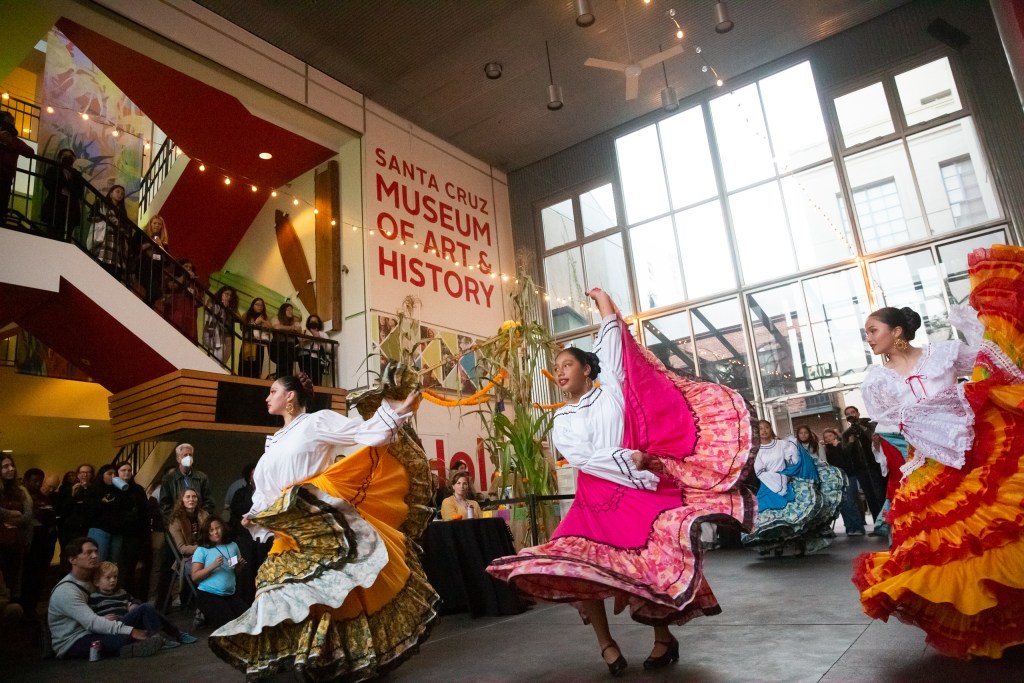
Senderos Centeotl Danza y Baile folklorico dance group performs at the Santa Cruz Museum of Art & History as part of the 2022 All-In Conference: Co-Creating Knowledge for Justice.
Now, not only can they do it, but also the team has become adept at organizing “rapid-response events,” says Benner, able to put them together at a moment’s notice during unfolding world events as they did in pulling together a broad panel of experts to talk about the background and context of the war in Ukraine.
Newer to the institute, Managing Director Ned LeBlond, previously of the Office of Research, is also working to ensure a two-way street: the institute’s “staff come from the communities and know the nonprofit leaders, have those relationships, and can help faculty to establish new partnerships,” he says, ensuring communities “participate in the process of what kind of knowledge is produced, and how we use that knowledge to effect change.”
For instance, the Center for Labor and Community’s youth worker survey conducts interviews with 3,000 individuals to “engage with the needs of those communities,” he says. “It’s not just creating an environment where academia can communicate to a community.”
In years to come, Benner hopes this model of collaborative co-production of knowledge for justice will be seen not as innovative or different, but as “‘that’s the way we should be,’” and that the institute’s success will be “measured by the extent that we can help other people be successful, as a collaborative, supportive partner.”
Sustaining the future
Thinking toward this future, Dean Mitchell seeks to ensure that the institute is grounded in a financially sustainable system, hopefully receiving an endowment or a naming opportunity, “so that we have a steady stream of money that we know is going to be there over the long term,” she says. Her previous institution, the Simpson Center for the Humanities at the University of Washington, provides a good example of this type of secure support and its ongoing benefits. In addition to funding from the central administration, it received a transformative $5 million endowment from philanthropists Barclay and Sharon Simpson. With this secure funding, the center is able to facilitate experimental collaborations and innovative research on an annual basis.
Barrios Unidos’s Patstone (with whom Benner also conducted an in-depth interview on the KSQD Cutting Edge podcast) echoes the importance of securing opportunities for future generations.
“I would invite those with access to resources to consider collaborating with the institute,” he says. “The solutions to the most pressing social issues of our time must come from those who have been most directly impacted. When you give an opportunity to students with historically marginalized backgrounds to enact social change, you will find that they often go above and beyond. For students like myself, the fruits of our labor are what will ultimately transform the very systems that held us back.”